Thursday, July 29, 2010

Anti-Zionism - facts (and fictions) By Howard Jacobson


Sunday, May 30, 2010

An Author's Self Respect

Better to write for yourself and have no public, than to write for the public and have no self. 
Cyril Connolly

Friday, February 26, 2010

Abraham and the Freedom of Speach

I remember that is was a warm sunny late spring day. The kind of day, a harbinger of long lazy summer days yet to some. It was probably a Saturday. My pleasure trip for such a day was to walk to the Wellington Park library where an impressive stone building had been built on the edge of the large tree lined park that encompassed an entire city block. I must have been around thirteen or fourteen. In those days I'd simply troll the aisles until I found something that caught my attention, then I'd devour the entire book or books for the remainder of the day.

The row of books on world religions was well known to me. I think that is why the book, newly entered and placed on the shelf caught my eye. The shiny plastic protective cover made it stand out from the older, worn and used texts that had rested on those selves, who knows, perhaps since the library's establishment. It was a recent edition of the Jewish Publication Society's English translation of the first five books of the Old Testament (as I called it then). The very idea that the Jews had a version of the Bible peaked my curiosity. That should indicate the level of my appreciation for the finer points of the so called Judeo-Christian tradition.

It was the only book I took out that day. I settled myself under the sheltering boughs of some great tree that had been planted at least eighty years earlier, and I marvelled that any living thing could have lived so long and still continued to thrive. I remember all this with such remarkable clarity that it embarrasses me to admit I have trouble remembering what I did or where I went last week. Once open, I became immersed in the book, totally oblivious to my surroundings. The story, the biblical narrative, written in what was for me such a readable language when compared with the arcane stilted English of the Christian King James translation, captivated me.

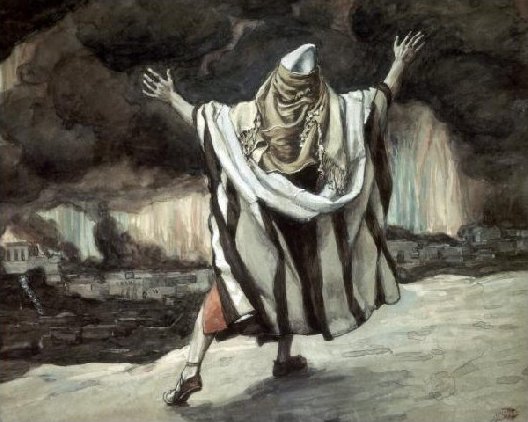
I distinctly remembering the moment when I read Abraham's debate with G-d! It was more than a dialogue. No matter how self effacing and circumspect Abraham tried to be, I sensed he was struggling with G-d himself to determine what was right and what was wrong. As I write these words I can again feel the goose pimples on my flesh that I felt the very first time I read Abraham's challenge to the creator and continuing source of all existence. What if there was a quorum of righteous men still residing in the city of Sodom, what a unthinkable thing to kill the righteous with the wicked as though there was no distinction between them. Then he said : ”Will the judge of all existence not do justice?” (Genesis 18:25)

Little did I appreciate it at the time, but these words, this personal introduction to a man who supposedly lived and died thousands of years earlier, would become a pivotal point in my life, ultimately leading to my decision to live as an observant Jew. As a result, I find it fascinating when others read into this same short exchange the source of inspiration for some of the values which form the foundation of modern Western Civilization. To this end I share an excerpt from the transcript of an interview I recently read in which Professor Paul Eidelberg explores the connection between this bible story and the concept of Freedom of Speech. Enjoy!

Recall the patriarch Abraham's questioning God's decision to destroy Sodom: "*What if there should be fifty righteous people in the midst of the city? Would you still stamp it out rather than spare the place for the sake of the fifty righteous people within it? It would be sacrilege to You to do such a thing, to bring death upon the righteous along with the wicked; “Shall the Judge of all the earth not do justice? “(Genesis 18:23-25.)

God permits Abraham to question Him. Can you imagine any Muslim questioning Allah?

Abraham's dialogue with God means that God is not only a God of justice, but also of reason.

This tells us what it means to be created in the image of God. It tells us about man's unique power to speak and communicate with others. It needs to be stressed, however, that Abraham's dialogue with God reveals the ultimate object of speech - Truth. Indeed, the Hebrew word for truth is *emet*, one of the names of God.

We also learn from Abraham's questioning of God that the God of the Jews, unlike the god worshipped by Muslims, is a God of freedom, a freedom that dwells with reason and kindness.

Going further, by telling us how Abraham spoke up and questioned the King of king's judgement regarding Sodom, the Torah is teaching us that we have a right to question the laws of any government, hence, that freedom of speech is a fundamental human right. However, this right must be understood from a Judaic perspective. The only rational justification for freedom of speech is man's creation in the image of G-d.

Only because man is endowed with reason and free will does he possess a right to freedom of speech, which includes the right to question the policies of government. To be consistent with man's creation in the image of God, government must be based on the primacy of reason or persuasion, as opposed to the primacy of coercion. Only the former would be acceptable to the God of Abraham.

From Genesis we learn that speech is not an end-in-itself or a mere exercise of self-expression. The basic function of speech is to communicate ideas about justice or the common good, or about what is true and what is false. To divorce speech from truth and justice is to reduce this distinctively human faculty to a mere instrument of self-aggrandizement. This is the tendency of normless democracy, which degrades man and makes nonsense of his right to freedom of speech.

It cannot be said too often that if freedom of speech is divorced from truth and justice, democracy is no more justifiable than tyranny. In other words, if there are no universally valid or objective standards as to how man should live, then there are no rational grounds for preferring democracy to tyranny. Immature minds contend, however, that relativism conduces to tolerance. But relativism undermines any objective ground for preferring
tolerance to intolerance.

Similarly, some silly f intellectuals contend that moral relativism is a precondition of academic freedom. But academic freedom can have no justification unless it is commonly understood that it is wrong to cheat or plagiarize or steal or slander one's colleagues. This suggests that moral relativists, who very much dominate academia, take civilization for
granted.

The father of civilization is none other than Abraham, whom the Torah refers to as the father of nations. The Torah portrays Abraham as the teacher of ethical monotheism which, together with the Genesis conception of man's creation in the image of God, provides the foundation for the moral unity of human nature and the idea of the human community.

The Bible of Israel thus contains, in my opinion, the most rational justification for freedom of speech, which point to its ethical limits. Apart from such limits, freedom of speech is mere noise or mischievous nonsense.

*Transcript of the Eidelberg Report,
Israel National Radio, Feb. 22, 2010,
written in honour of George Washington's birthday.

Friday, December 18, 2009

Why I Don't Demonstrate


I used to. There isn't a demonstration connected to Eretz Israel that some representive of our family hasn't participated it, at least since our return in 1992. The reason I personally no longer participate stems from two separate reasons.

The first is self evident. It is a waste of time. Over two hundred and fifty thousand people crowded around the Israeli Kenesset building on the eve of the vote in favour of the Oslo Accords, all we got was a derisive mark by the Prime Minister at that time that we don't "move him" (Read ther fact that 250,000 citizens out of a population of 5 million left home late at night to camp outside the israeli Parliament building doesn't give him a hard on!) At best, demonstrations are escape values to let off pressure, let people feel they are doing something, when in reality there is absolutely no connection between the Israeli electorate and the elected in Israel once the ballots have been dropped in the box.

That leads into my second reason, why this particular set of demonstrations against the "Building Freeze" doesn't earn my involvement. Instead of attacking the real issue, the fundemental flaw in the Israeli political system that makes Oslo's and arbitrary negation of a citizen's rights something politicans can decide to do for whatever spurious reasons they want to provide, the organizers are attacking the decision as if it a sectorial issue of lack of building permits for one particular population.

Tzippi Hutiel said it best when she participated in the Press Conference on Saturday Night. The issue we should be protesting is the bankruptcy of the Israeli Democratic process! The bankruptcy of the Likud party as part of that system. Any system that permits the leading political parties to get elected on one very clear and articulated platform and yet consistently turns around and does exactly the opposite, is at best bankrupt, at worst corrupt to the core.

I have no doubt that when the day will come and some assute (and brave) person raises the banner of the need for a Renewal of Democracy in the Israeli political system, they will receive support from every segment of the Israeli electorate. The Left (and some of the leadership of the Right) like to talk about the chissim between the political ideaologies within Israel, but from where I sit, very close to the ground and far from positions of influence and power, the real chissim is between Israeli's leadership and the people they pretend to represent. The bitterness and dissolutionment grows greater year after year. The percentage of the general public that has faith in the Justice system, in the political establishment and in the Israeli government's ability to meet the needs of the people plumets from one poll to the next.

So, when someone holds a demonstration to demand a dramatic change to the Israeli electoral system which promises to make elected officals accountable to the people who elected them, let me know, I'll be the first to show up. Until then, stop wasting my time and confusing the issue with sectorial irrelivancies. Until the system is changed, you'll run from one brush fire to the next without ever having solved anything. It's a shame because in my opinion we can't waste too much more time.

Wednesday, December 09, 2009

The Jew from Kuwait

[As my dear friend Dr. Block is mentioned in a very meaningful way in this story I felt the need to post it so I can return to it from time to time. There are echos of my story and my persional relationship with Dr. Block in this story. YBA]
The Jew from Kuwait
by Mark Halawa

My Muslim background left me unprepared for this shocking discovery.

Growing up in Kuwait, I had the best of everything. My father owned a successful construction company, and provided us five children with amenities like piano lessons, swimming, calligraphy and trips all over the world. Although we were Muslims like everyone else, we were totally secular and my father always aimed to shield us from religious people whom he described as crazies.

I grew up being told that Israelis and Jews were the lowest type of creature in existence, put on Earth only to kill us Arabs. In math class the teacher would say, “If one rocket killed X number of Jews, how many would six rockets kill?”

My father was rabidly anti-Israel. He was a product of Nasser's school of thought: secular from a Muslim point of view, yet deeply dedicated to the idea of pan-Arab unity. Israel, he believed, was an American proxy in the post-colonial Middle East.

My father was a supporter of the PLO since the 1960s when Yasser Arafat (who founded the PLO while living in Kuwait) was raising money from wealthy Palestinians working in Gulf States. As an engineer, my father participated in a program where the engineering association in Kuwait would deduct money from his monthly salary to be sent directly to the PLO. He insisted that war and resistance was the only way to deal with Israel.

In the summer of 1990, when I was 12 years old, our lives changed completely. We were on vacation when Saddam Hussein invaded and annexed Kuwait. My father's business -- along with much of the country -- was ravaged. Our savings became worthless pieces of paper. We could not go back to Kuwait, so we immigrated to Canada. My father did manage to sneak back in for a few days to retrieve important business documents that would later be useful in recovering compensation from a United Nations fund.

Praying in the Dark

Of my family, I’m the only one who stayed in Canada. My father never really adjusted to life in the New World, and he had good business contacts back in Jordan, so my parents returned there. All my siblings also moved back to the Middle East. One brother runs a successful company in Jordan, two brothers are studying in Egypt (one dentistry and the other business), and my sister lives in Dubai where she works in the banking industry.

One evening in 2003, I was studying at the university library in London, Ontario, when I happened to notice an older man. From his chassidic garb, he looked like a religious Jew. My curiosity was aroused, so I approached him and asked, "Are you Jewish?"

With a gentle smile on his face, he said, "No, but I like to dress this way." I didn't know whether he was joking or not. All the religious people I had come across in the past were pretty scary. Are Jews supposed to be funny?

His name was Dr. Yitzhak Block, a retired professor of philosophy. We exchanged a few words and then he asked about my background. My family history is pretty complex, and I get a headache every time I have to explain it all. So I simply told him that I'm an Arab from Kuwait, and mentioned that my grandmother from my mother’s side is Jewish.

My mother’s parents met in Jerusalem when my grandfather, an Arab from the West Bank, was serving in the Jordanian army fighting the Zionists. He was 18 years old and my grandmother was 16. Her father ran a school in Jerusalem -- the same school where she would jump off the wall to meet my handsome, uniformed grandfather. They fell in love, got married, and lived for a number of years in Shechem (Nablus).

After my grandfather was discharged from the Jordanian army, the family moved to Kuwait, where oil profits were fueling huge business and construction projects. That’s where my mother met my father and got married.

Knowing about my grandmother’s Jewish background always made me curious about Jews. Whenever we were on vacation in Amman, Jordan, I used to constantly watch the Israeli channel -- when my parents weren't around. My favorite was the Israeli national anthem, and I would stay up late waiting to hear them play it at the end of the TV transmission.

Standing there in the university library, this religious Jew, Dr. Block, looked at me and said, “In Muslim law, you’re considered Muslim, since the religion goes by the father. But according to Jewish law, you’re Jewish, since Jewish identity is transmitted by the mother.”

My head started to spin and memories of my childhood in Kuwait began to surface. I recalled how my grandmother had a funny name on her documents, Mizrachi, which I never heard before. She also had a small prayer book with Hebrew letters, and she prayed in the dark crying. (I thought the Wailing Wall was so named because crying was a part of prayer.)

Aside from a vague family legend, my grandmother never mentioned anything about being Jewish -- but now the pieces were fitting into place. I thanked Dr. Block for the conversation, and ran home to tell my roommate what I heard. He smiled and said, “So you're a Mus-Jew!” I was not amused.

I went to my room and called my mother. She rebuffed the story, saying, "Don't listen to people like that. We are Muslims and that's that."

I decided to call my grandmother myself and bring up the subject.

I beat around the bush a bit -- after all, she’d been denying it for the past 50 years -- and then finally blurted out, “Grandma, are you Jewish?”

She didn’t answer the question directly, but she started crying and spoke about the years of Arab-Israeli conflict. She told me how her brother Zaki had been killed in Jerusalem before the rebirth of the State. To me that was sufficient confirmation of her Jewishness and I decided to leave it at that.

Over the next few months, I avoided the whole issue of Judaism, mainly for the sake of not upsetting my mother. Besides, I was just finishing university, and career was my main priority. I was content with telling myself that I belonged to a mixed-faith family.

Streaming Tears

About a year later, I was rollerblading one day in my neighborhood when I took a hard fall and badly sprained my wrist. The road was smooth so I couldn't figure out why I had fallen. I couldn’t stop thinking that it seemed like a push from Above. These thoughts caught me by surprise, since I wasn't into spirituality and I never had any religious connection. I was a bodybuilder, had tons of friends, and was on the heels of a successful career as a foreign exchange trader. So why had this happened?

Because my wrist was heavily bandaged, I was forced to take off work for a few days. Dr. Block had mentioned the name of his synagogue, so that Saturday morning, I decided to go check out the scene. I was hesitant at the thought of everyone being from European background and me the only Middle Easterner, but I decided to go anyway.

I called a cab and got dropped off at the synagogue. As I walked in, the first person I saw looked Indian. He shook my hand, said “Shabbat Shalom,” and handed me a kippah. Then I saw a black man which really surprised me. And Dr. Block was there, too.

I was handed a prayer book, shown the proper page, and before I knew it everyone was singing, V'Shamru:

"And the Children of Israel shall keep the Sabbath, to make the Sabbath an eternal covenant for their generations. Between Me and the Children of Israel, it is a sign forever that in six days God made heaven and earth, and on the seventh day He rested and was refreshed."

Something hit me and I felt as though I knew this song. I just stood there taking in the sounds, the smells and the sights. Everything felt whole and perfect. It was the opposite of everything I'd ever heard about Jews or Judaism. At this point my tears were streaming in freefall.

After the services finished, I met everyone over Kiddush. I spoke with an Egyptian couple and we shared our personal stories. Jews from all backgrounds were gathered together and I was another piece of this puzzle.

After Kiddush, I accepted Dr. Block’s invitation to join him for lunch. I told him: “I can’t believe I'm here, singing and praying in Hebrew. I could never have imagined it.”

He smiled and said, "It's not so hard to believe. Every Jew is born with a little Torah and a little Menorah inside.” He then pressed his shoulder up against mine and said, “All it takes is for another Jew to bump into him and light it up."

Dreams of Peace

My interest grew from there, and I began studying Torah and keeping Shabbat. Last year I spent a month in Israel touring and studying on Aish HaTorah’s Jerusalem Fellowships program. It was a great “homecoming.”

I still keep in close contact with my family and old friends. They’re wonderful people and I love them very much. Yet it’s hard to relate to them on many levels. In the Arab world there are tons of misconceptions and misinformation regarding Israel. So I am working to develop a program to educate Arabs about Jews and Judaism, to dissolve the stereotypes propagated by the Muslim media and schools. I hope that my unique background can help bridge some of that divide.

Another way I hope to achieve this is to help establish economic relations between Israel and Arab countries. That would create trust and shared experience, which could be directed toward the goal of a genuine and lasting peace.

Another issue I’m trying to address is how the Arab world is filled with Holocaust denial. This past summer I went to Auschwitz, and I am working to produce the first-ever Arabic documentary about the Holocaust. I want to explain to Muslims in their own language exactly what happened.

It often seems like the Arab-Israeli conflict is intractable. Yet I believe in today’s world, there is a real opportunity for a breakthrough. Arabs today have a more universal education, which makes them more open and curious. Also they are meeting Israelis and Jews in their travels around the world, which breaks down misconceptions. And as we saw during the recent protests in Iran, many young people in the Muslim world are yearning for reform. On top of all this, they have high-speed Internet access which opens up all kinds of new avenues of communication, and the possibility of forming new friendships unrestricted by borders or political agendas. Perhaps this can be the basis of a grassroots movement to mend relations and hopefully one day achieve peace.

The other issue that needs urgent attention is intermarriage in Israel. Unfortunately, a story like my grandmother's is not so rare. Many young Jewish women are wooed by Arab men and brought back to live in their villages. The children and grandchildren are never told the truth, especially with political tensions and the emotional unrest this would cause a family. As a result, many Jews are lost to our people. My mother has five sisters, and from there I have a few dozen cousins who are all Jewish -- all living as Muslims in the Middle East. I recently met a seventh-generation Israeli, whose cousin married a Palestinian and went to live in Saudi Arabia; her descendents are Jews living in Saudi Arabia.

All my relatives know that I’m practicing Judaism, and for the most part they’re accepting. I can talk to them about Judaism and they’re politely interested. We love and respect each other. My father is resistant, however, given that secularism and war against Israel are the two ideological pillars of his life. When I first became interested in Judaism, I didn’t tell him straight out. We were having a political discussion and I mentioned that I support the State of Israel. That ignited a big clash and I’ve learned to only discuss these matters with him in an indirect way. I always know when I’ve crossed the line; he gets angry and calls me a “Zionist.”

The other big exception -- not surprisingly -- is my grandmother. I’ve asked her a number of times for more information about her family background, but she refuses to talk about it. Maybe one day I will find the key to opening her up.

Growing up, I was taught that Jews were the source of all evil, descended from monkeys and pigs. On the other hand, I had the image of my grandmother holding her small prayer book with the Hebrew letters, praying with tender devotion. She is the sweetest person I know and there's no way she came from a bloodthirsty gang of murderers. She gave me a Jewish soul, and in her own way, it was she who kept my Jewish spark alive.