Thursday, August 05, 2010

We Owe the Jews

What follows is an edited version of a speech delivered by historian Andrew Roberts to the Friends of Israel Initiative in the British House of Commons on July 19, published in the National Post · Tuesday, Aug. 3, 2010

From Morocco to Afghanistan, from the Caspian Sea to Aden, the 5.25 million square miles of territory belonging to members of the Arab League is home to over 330 million people, whereas Israel covers only 8,000 square miles, and is home to seven million citizens, one-fifth of whom are Arabs. The Jews of the Holy Land are thus surrounded by hostile states 650 times their size in territory and 60 times their population; yet their last, best hope of ending two millennia of international persecution -- the State of Israel -- has somehow survived. When during the Second World War, the island of Malta came through three terrible years of bombardment and destruction, it was rightly awarded the George Medal for bravery. Today Israel should be awarded a similar decoration for defending democracy, tolerance and Western values against a murderous onslaught that has lasted 20 times as long.

Jerusalem is the site of the Temple of Solomon and Herod. The stones of a palace erected by King David himself are even now being unearthed just outside the walls of Jerusalem. Everything that makes a nation state legitimate -- blood shed, soil tilled, international agreements -- argues for Israel's right to exist, yet that is still denied by the Arab League. For many of their governments, which are rich enough to have economically solved the Palestinian refugee problem decades ago, it is useful to have Israel as a scapegoat to divert attention from the tyranny, failure and corruption of their own regimes.

The tragic truth is that it suits Arab states very well to have the Palestinians endure permanent refugee status; whenever Israel puts forward workable solutions they are stymied by those whose interests put the destruction of Israel before the genuine well-being of the Palestinians. Both King Abdullah I of Jordan and Anwar Sadat of Egypt were assassinated when they attempted to come to some kind of accommodation with a country that most sane people now accept is not going away.

"We owe to the Jews," wrote Winston Churchill in 1920, "a system of ethics which, even if it were entirely separated from the supernatural, would be incomparably the most precious possession of mankind, worth in fact the fruits of all wisdom and learning put together." Although they make up less than half of 1% of the world's population, between 1901 and 1950 Jews won 14% of all the Nobel Prizes awarded for literature and science, and between 1951 and 2000 Jews won 32% of the Nobel Prizes for medicine, 32% for physics, 39% for economics and 29% for science. This, despite so many of their greatest intellects dying in the gas chambers. Yet we tend to treat Israel like a leper on the international scene, threatening her with academic boycotts if she builds a separation wall that has so far reduced suicide bombings by 95% over three years.

Her Majesty the Queen has been on the throne for 57 years and in that time has undertaken 250 official visits to 129 countries, yet has not yet set foot in Israel. She has visited 14 Arab countries, so it cannot have been that she wasn't in the region.

After the Holocaust, the Jewish people recognized that they must have their own state, a homeland where they could forever be safe from a repetition of such horrors. Since then, Israel has had to fight five major wars for her existence. Radical Islam is never going to accept the concept of an Israeli State, so the struggle is likely to continue for another 60 years, but the Jews know that that is less dangerous than entrusting their security to anyone else.

I recently visited Auschwitz-Birkenau. Walking along a line of huts and the railway siding, where their forebears had been worked and starved and beaten and frozen and gassed to death, were a group of Jewish schoolchildren, one of whom was carrying over his shoulder the Israeli flag. It was a moving sight, for it was the sovereign independence represented by that flag which guarantees that the obscenity of genocide will never again befall the Jewish people.

No people in history have needed the right to self-defence and legitimacy more than the Jews of Israel, and that is what we in the Friends of Israel Initiative demand here today.

Thursday, July 29, 2010

Anti-Zionism - facts (and fictions) By Howard Jacobson


Sunday, May 30, 2010

An Author's Self Respect

Better to write for yourself and have no public, than to write for the public and have no self. 
Cyril Connolly

Friday, February 26, 2010

Abraham and the Freedom of Speach

I remember that is was a warm sunny late spring day. The kind of day, a harbinger of long lazy summer days yet to some. It was probably a Saturday. My pleasure trip for such a day was to walk to the Wellington Park library where an impressive stone building had been built on the edge of the large tree lined park that encompassed an entire city block. I must have been around thirteen or fourteen. In those days I'd simply troll the aisles until I found something that caught my attention, then I'd devour the entire book or books for the remainder of the day.

The row of books on world religions was well known to me. I think that is why the book, newly entered and placed on the shelf caught my eye. The shiny plastic protective cover made it stand out from the older, worn and used texts that had rested on those selves, who knows, perhaps since the library's establishment. It was a recent edition of the Jewish Publication Society's English translation of the first five books of the Old Testament (as I called it then). The very idea that the Jews had a version of the Bible peaked my curiosity. That should indicate the level of my appreciation for the finer points of the so called Judeo-Christian tradition.

It was the only book I took out that day. I settled myself under the sheltering boughs of some great tree that had been planted at least eighty years earlier, and I marvelled that any living thing could have lived so long and still continued to thrive. I remember all this with such remarkable clarity that it embarrasses me to admit I have trouble remembering what I did or where I went last week. Once open, I became immersed in the book, totally oblivious to my surroundings. The story, the biblical narrative, written in what was for me such a readable language when compared with the arcane stilted English of the Christian King James translation, captivated me.

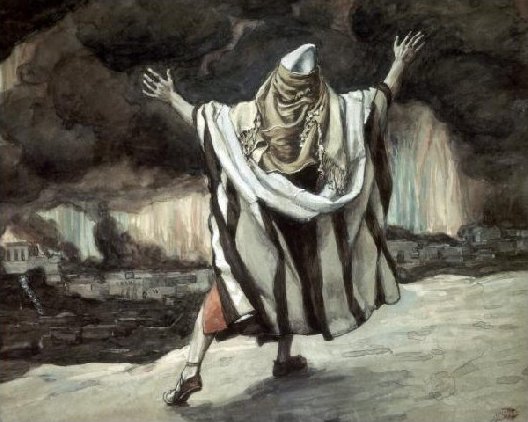
I distinctly remembering the moment when I read Abraham's debate with G-d! It was more than a dialogue. No matter how self effacing and circumspect Abraham tried to be, I sensed he was struggling with G-d himself to determine what was right and what was wrong. As I write these words I can again feel the goose pimples on my flesh that I felt the very first time I read Abraham's challenge to the creator and continuing source of all existence. What if there was a quorum of righteous men still residing in the city of Sodom, what a unthinkable thing to kill the righteous with the wicked as though there was no distinction between them. Then he said : ”Will the judge of all existence not do justice?” (Genesis 18:25)

Little did I appreciate it at the time, but these words, this personal introduction to a man who supposedly lived and died thousands of years earlier, would become a pivotal point in my life, ultimately leading to my decision to live as an observant Jew. As a result, I find it fascinating when others read into this same short exchange the source of inspiration for some of the values which form the foundation of modern Western Civilization. To this end I share an excerpt from the transcript of an interview I recently read in which Professor Paul Eidelberg explores the connection between this bible story and the concept of Freedom of Speech. Enjoy!

Recall the patriarch Abraham's questioning God's decision to destroy Sodom: "*What if there should be fifty righteous people in the midst of the city? Would you still stamp it out rather than spare the place for the sake of the fifty righteous people within it? It would be sacrilege to You to do such a thing, to bring death upon the righteous along with the wicked; “Shall the Judge of all the earth not do justice? “(Genesis 18:23-25.)

God permits Abraham to question Him. Can you imagine any Muslim questioning Allah?

Abraham's dialogue with God means that God is not only a God of justice, but also of reason.

This tells us what it means to be created in the image of God. It tells us about man's unique power to speak and communicate with others. It needs to be stressed, however, that Abraham's dialogue with God reveals the ultimate object of speech - Truth. Indeed, the Hebrew word for truth is *emet*, one of the names of God.

We also learn from Abraham's questioning of God that the God of the Jews, unlike the god worshipped by Muslims, is a God of freedom, a freedom that dwells with reason and kindness.

Going further, by telling us how Abraham spoke up and questioned the King of king's judgement regarding Sodom, the Torah is teaching us that we have a right to question the laws of any government, hence, that freedom of speech is a fundamental human right. However, this right must be understood from a Judaic perspective. The only rational justification for freedom of speech is man's creation in the image of G-d.

Only because man is endowed with reason and free will does he possess a right to freedom of speech, which includes the right to question the policies of government. To be consistent with man's creation in the image of God, government must be based on the primacy of reason or persuasion, as opposed to the primacy of coercion. Only the former would be acceptable to the God of Abraham.

From Genesis we learn that speech is not an end-in-itself or a mere exercise of self-expression. The basic function of speech is to communicate ideas about justice or the common good, or about what is true and what is false. To divorce speech from truth and justice is to reduce this distinctively human faculty to a mere instrument of self-aggrandizement. This is the tendency of normless democracy, which degrades man and makes nonsense of his right to freedom of speech.

It cannot be said too often that if freedom of speech is divorced from truth and justice, democracy is no more justifiable than tyranny. In other words, if there are no universally valid or objective standards as to how man should live, then there are no rational grounds for preferring democracy to tyranny. Immature minds contend, however, that relativism conduces to tolerance. But relativism undermines any objective ground for preferring
tolerance to intolerance.

Similarly, some silly f intellectuals contend that moral relativism is a precondition of academic freedom. But academic freedom can have no justification unless it is commonly understood that it is wrong to cheat or plagiarize or steal or slander one's colleagues. This suggests that moral relativists, who very much dominate academia, take civilization for
granted.

The father of civilization is none other than Abraham, whom the Torah refers to as the father of nations. The Torah portrays Abraham as the teacher of ethical monotheism which, together with the Genesis conception of man's creation in the image of God, provides the foundation for the moral unity of human nature and the idea of the human community.

The Bible of Israel thus contains, in my opinion, the most rational justification for freedom of speech, which point to its ethical limits. Apart from such limits, freedom of speech is mere noise or mischievous nonsense.

*Transcript of the Eidelberg Report,
Israel National Radio, Feb. 22, 2010,
written in honour of George Washington's birthday.

Friday, December 18, 2009

Why I Don't Demonstrate


I used to. There isn't a demonstration connected to Eretz Israel that some representive of our family hasn't participated it, at least since our return in 1992. The reason I personally no longer participate stems from two separate reasons.

The first is self evident. It is a waste of time. Over two hundred and fifty thousand people crowded around the Israeli Kenesset building on the eve of the vote in favour of the Oslo Accords, all we got was a derisive mark by the Prime Minister at that time that we don't "move him" (Read ther fact that 250,000 citizens out of a population of 5 million left home late at night to camp outside the israeli Parliament building doesn't give him a hard on!) At best, demonstrations are escape values to let off pressure, let people feel they are doing something, when in reality there is absolutely no connection between the Israeli electorate and the elected in Israel once the ballots have been dropped in the box.

That leads into my second reason, why this particular set of demonstrations against the "Building Freeze" doesn't earn my involvement. Instead of attacking the real issue, the fundemental flaw in the Israeli political system that makes Oslo's and arbitrary negation of a citizen's rights something politicans can decide to do for whatever spurious reasons they want to provide, the organizers are attacking the decision as if it a sectorial issue of lack of building permits for one particular population.

Tzippi Hutiel said it best when she participated in the Press Conference on Saturday Night. The issue we should be protesting is the bankruptcy of the Israeli Democratic process! The bankruptcy of the Likud party as part of that system. Any system that permits the leading political parties to get elected on one very clear and articulated platform and yet consistently turns around and does exactly the opposite, is at best bankrupt, at worst corrupt to the core.

I have no doubt that when the day will come and some assute (and brave) person raises the banner of the need for a Renewal of Democracy in the Israeli political system, they will receive support from every segment of the Israeli electorate. The Left (and some of the leadership of the Right) like to talk about the chissim between the political ideaologies within Israel, but from where I sit, very close to the ground and far from positions of influence and power, the real chissim is between Israeli's leadership and the people they pretend to represent. The bitterness and dissolutionment grows greater year after year. The percentage of the general public that has faith in the Justice system, in the political establishment and in the Israeli government's ability to meet the needs of the people plumets from one poll to the next.

So, when someone holds a demonstration to demand a dramatic change to the Israeli electoral system which promises to make elected officals accountable to the people who elected them, let me know, I'll be the first to show up. Until then, stop wasting my time and confusing the issue with sectorial irrelivancies. Until the system is changed, you'll run from one brush fire to the next without ever having solved anything. It's a shame because in my opinion we can't waste too much more time.